
🇬🇧 English text at the bottom 🇬🇧
L’esigenza di preservare le merci deperibili durante i lunghi viaggi oceanici ha plasmato la storia economica dell’Europa moderna, trasformando una necessità logistica in una delle più importanti scoperte enologiche di sempre. Prima dell’avvento della refrigerazione, il mare era un ambiente ostile per le derrate alimentari e il vino, sottoposto a sbalzi termici e continui scuotimenti, finiva inevitabilmente per ossidarsi o spuntare. La soluzione empirica sviluppata dai mercanti inglesi fu l’alcolizzazione, un processo tecnico che arrestava le fermentazioni e stabilizzava il liquido, creando di fatto la categoria dei vini fortificati. Questa genesi prettamente utilitaristica, lontana da qualsiasi romanticismo, ha gettato le basi per la nascita di prodotti di straordinaria longevità e complessità chimico-fisica.
Nel 1773 il commerciante di Liverpool John Woodhouse approdò per una tempesta nel porto di Marsala e, assaggiando il vino locale perpetuo, intuì che con l’aggiunta di acquavite avrebbe potuto affrontare il viaggio verso l’Inghilterra senza alterarsi, per competere commercialmente con il Porto e il Madeira. Nacque così il Marsala, il cui successo fu tale da attirare altri imprenditori britannici come Ingham e Whitaker, e in seguito italiani come Vincenzo Florio nel 1833. Oggi la legislazione italiana, attraverso un rigido disciplinare, classifica il Marsala in base agli anni di invecchiamento e al residuo zuccherino. Si parte dal Fine con 1 anno di maturazione, per passare al Superiore con 2 anni e al Superiore Riserva con 4 anni. Il vertice qualitativo assoluto è tuttavia rappresentato dal Marsala Vergine, o Soleras, che richiede almeno 5 anni di invecchiamento in legno, i quali diventano 10 per la menzione Riserva. A livello di dolcezza, il Marsala si divide in secco con meno di 40 grammi per litro di zucchero, semisecco tra 40 e 100 grammi e dolce oltre i 100 grammi. Il Vergine fa eccezione assoluta in quanto può essere esclusivamente secco, con un residuo zuccherino che per legge non deve superare i 40 grammi per litro e nel quale è severamente vietata l’aggiunta di mosto cotto o concentrato.
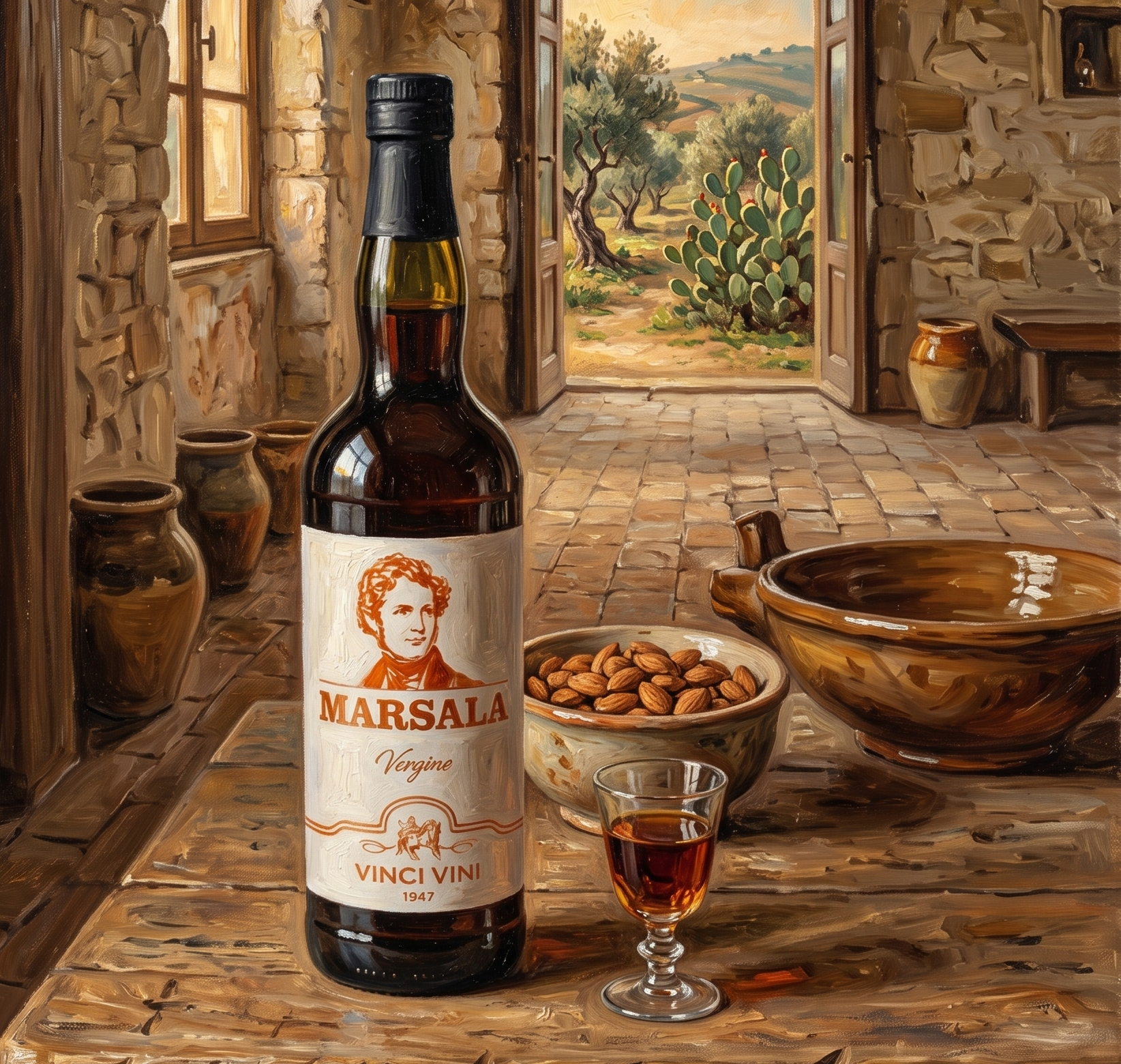
L’espressione più rigorosa di questa tipologia si materializza nel Marsala Vergine DOC prodotto dalle Cantine Vinci, un vino che esaspera i dettami del disciplinare sottoponendo il liquido a una maturazione di oltre 10 anni in botti di rovere americano, ben oltre i 5 anni minimi richiesti. Frutto di un assemblaggio paritario di uve Grillo e Catarratto allevate a spalliera nell’agro marsalese e vendemmiate a settembre, questo vino base viene addizionato unicamente con alcol etilico di origine vinicola, raggiungendo un tenore alcolico del 19 per cento con un residuo zuccherino quasi assente, inferiore a 10 grammi per litro. Nel calice si presenta con una veste giallo oro antico solcata da lievi riflessi ambrati. Il profilo olfattivo è un concentrato di evoluzione ossidativa, netto e privo di ruffianerie, dove l’iniziale austerità lascia emergere in un secondo momento precisi sentori di buccia d’arancia, miele e frutta a polpa gialla sotto spirito, innestati su una trama di spezie dolci cedute dal lungo affinamento nel legno. Al palato l’ingresso è possente e asciutto, rivelando una struttura imponente e un carattere alcolico marcato che richiede totale attenzione. La corrispondenza gusto-olfattiva è assoluta, risolvendosi in una persistenza che si protrae a lungo, asciugando il palato e predisponendolo all’abbinamento gastronomico.
Le caratteristiche chimico-fisiche e organolettiche di un simile Marsala Vergine impongono scelte a tavola millimetriche, escludendo a priori i dolci lievitati o ricchi di creme delicate che verrebbero annientati dalla spinta alcolica. L’accordo perfetto si realizza per contrapposizione strutturale con i formaggi erborinati o a lunghissima stagionatura, le cui note piccanti e sapide trovano un bilanciamento ideale nella potenza del vino. Per concordanza, l’abbinamento territoriale si esalta con la pasta di mandorle o i tradizionali biscotti secchi tagliancozzi, mentre l’unione con il cioccolato fondente di Modica sfrutta la secchezza estrema del liquido per ripulire la bocca dalla pastosità del cacao, creando una sinergia tecnica in cui la componente ossidativa del Marsala funge da perfetto moltiplicatore aromatico.
In definitiva, il Marsala Vergine trascende la sua stessa natura di bevanda per farsi metafora di una resistenza silenziosa contro la dittatura dell’istante. Bere questo vino significa decifrare un orologio liquido le cui lancette si sono fermate decenni fa nel buio di una cantina siciliana, permettendo al tempo e all’ossigeno di scolpire la materia. È un invito a riappropriarsi dell’attesa, a comprendere che la vera grandezza non si ottiene forzando i ritmi della natura, ma assecondandoli con rispettosa devozione. In ogni sorso si nasconde l’eco di generazioni passate e la promessa di un piacere che non ammette fretta, ricordandoci che le cose più preziose, proprio come i segreti meglio custoditi, esigono il giusto tempo per rivelarsi nella loro forma più sublime.
🇬🇧 English version 🇬🇧

The paradox of liquid time: history, classification and rigor of Marsala Vergine
The need to preserve perishable goods during long ocean voyages shaped the economic history of modern Europe, transforming a logistical necessity into one of the most important enological discoveries ever. Before the advent of refrigeration, the sea was a hostile environment for food and wine, subjected to thermal shocks and constant shaking, inevitably ending up oxidized or spoiled. The empirical solution developed by English merchants was alcoholization, a technical process that stopped fermentations and stabilized the liquid, effectively creating the category of fortified wines. This purely utilitarian genesis, far from any romanticism, laid the foundations for the birth of products of extraordinary longevity and chemical-physical complexity.
In 1773 the Liverpool merchant John Woodhouse landed due to a storm in the port of Marsala and, tasting the local perpetual wine, realized that with the addition of spirit it could face the journey to England without altering, to compete commercially with Port and Madeira. Thus Marsala was born, whose success was such as to attract other British entrepreneurs like Ingham and Whitaker, and later Italians like Vincenzo Florio in 1833. Today Italian legislation, through a strict disciplinary, classifies Marsala based on years of aging and residual sugar. It starts from Fine with 1 year of maturation, moving to Superiore with 2 years and Superiore Riserva with 4 years. The absolute qualitative peak is however represented by Marsala Vergine, or Soleras, which requires at least 5 years of aging in wood, which become 10 for the Riserva mention. In terms of sweetness, Marsala is divided into dry with less than 40 grams per liter of sugar, semi-dry between 40 and 100 grams and sweet over 100 grams. Vergine is an absolute exception as it can only be dry, with a residual sugar that by law must not exceed 40 grams per liter and in which the addition of cooked or concentrated must is strictly prohibited.
The most rigorous expression of this typology materializes in the Marsala Vergine DOC produced by Cantine Vinci, a wine that exaggerates the dictates of the disciplinary by subjecting the liquid to a maturation of over 10 years in American oak barrels, well beyond the minimum 5 years required. The result of an equal blend of Grillo and Catarratto grapes grown on espaliers in the Marsala countryside and harvested in September, this base wine is added only with ethyl alcohol of viticultural origin, reaching an alcohol content of 19 percent with an almost absent residual sugar, less than 10 grams per liter. In the glass it presents itself with an antique gold color crossed by slight amber reflections. The olfactory profile is a concentrate of oxidative evolution, clean and devoid of pandering, where the initial austerity later allows precise scents of orange peel, honey and yellow-fleshed fruit in spirit to emerge, grafted onto a texture of sweet spices yielded by the long aging in wood. On the palate the entry is powerful and dry, revealing an imposing structure and a marked alcoholic character that requires total attention. The taste-olfactory correspondence is absolute, resolving in a persistence that lasts a long time, drying the palate and preparing it for a gastronomic pairing.
The chemical-physical and organoleptic characteristics of such a Marsala Vergine impose millimetric choices at the table, excluding a priori leavened desserts or those rich in delicate creams that would be annihilated by the alcoholic thrust. The perfect agreement is achieved by structural opposition with blue or very long-aged cheeses, whose spicy and savory notes find an ideal balance in the power of the wine. By concordance, the territorial pairing is enhanced with almond paste or the traditional dry tagliancozzi biscuits, while the union with dark Modica chocolate uses the extreme dryness of the liquid to clean the mouth from the pastiness of the cocoa, creating a technical synergy in which the oxidative component of Marsala acts as a perfect aromatic multiplier.
Ultimately, Marsala Vergine transcends its very nature as a beverage to become a metaphor for a silent resistance against the dictatorship of the instant. Drinking this wine means deciphering a liquid clock whose hands stopped decades ago in the darkness of a Sicilian cellar, allowing time and oxygen to sculpt the matter. It is an invitation to reclaim waiting, to understand that true greatness is not achieved by forcing the rhythms of nature, but by indulging them with respectful devotion. Hidden in every sip is the echo of past generations and the promise of a pleasure that admits no haste, reminding us that the most precious things, just like the best kept secrets, demand the right time to reveal themselves in their most sublime form.

Lascia un commento